

How Different Tanning Methods Change Leather Quality
Posted by The Green Tanners on 11th Dec 2025
Have you ever wondered why some leather jackets last for decades while others crack in a year? The secret often lies not just in the animal skin itself, but in the chemistry of the tanning process. Here is how different tanning methods fundamentally alter the quality, durability, and feel of your leather goods.
How Do Tanning Methods Affect Leather Quality?
Tanning methods are the single most significant factor in determining leather quality after the raw hide selection. The tanning process stabilizes the collagen fibers in the hide, preventing rot and giving the material its final characteristics.
Chrome tanning uses chromium salts to produce soft, pliable, and water-resistant leather quickly. This method results in uniform colors but often lacks the rich patina of age. Vegetable tanning uses natural tannins from tree bark. This slower process creates thick, durable leather that develops a unique character over time but is less water-resistant initially.
The method chosen dictates the leather's lifespan, how it reacts to water, its stiffness, and its environmental footprint. If you want a product built to last, you must understand how it was tanned.
Explore our: Leather Care Guide
Defining Key Leather Terms
Before we dive deeper, we need to clarify some industry terms. This helps you shop with confidence.
Tanning
Tanning is the chemical or organic process of treating animal skins to produce leather. It permanently alters the protein structure of the skin so it doesn't decompose.
Grain
Grain refers to the outside surface of the hide. "Full-grain" includes the entire outer layer and is the most durable. "Top-grain" has the top layer sanded off for a smoother look but less strength.
Thickness
Leather thickness is usually measured in ounces or millimeters. Higher thickness often correlates with vegetable tanning, which is ideal for belts and structured bags. Chrome tanning allows for thinner, softer leather suitable for garments.
Leather Grades
Grades rank the quality of the hide. Grade 1 (or A) has no flaws. Grades 2 and 3 have increasing amounts of blemishes. However, the tanning method can sometimes mask these grades or highlight them.
 |
Visit Our Leather Pants CollectionBrowse our full range of leather pants for parties, club nights, and play. Find cuts, fits, and finishes to match your style and scene. Visit collection |
The Chemistry of Chrome Tanning
Chrome tanning is the modern standard. Invented in the 19th century, it revolutionized the industry.
Speed and Softness
Chrome tanning is fast. Tanneries can finish a batch in a single day. The chromium ions bind rapidly to the collagen. This speed keeps costs low. It also produces leather that is soft right out of the box. You don't need to break in a chrome-tanned jacket like you do a stiff pair of boots.
Water Resistance
This method creates excellent water resistance. The chemical bonds repel moisture effectively. If you live in a rainy city, chrome-tanned boots might serve you well. However, this resistance comes at a cost. The leather doesn't "breathe" as well as vegetable-tanned options.
Environmental Impact
We must address the environmental concerns. Chrome tanning involves heavy metals. If not managed strictly, it can harm local water systems. At The Green Tanners, we prioritize sustainable leather options because we know our customers value eco-conscious choices.
The Art of Vegetable Tanning
Vegetable tanning is an ancient art. It uses organic materials like oak, chestnut, or quebracho bark.
Durability and Structure
Vegetable tanning takes time, often up to two months. This slow process results in a dense, sturdy fiber structure. This leather is "built to last." It is perfect for heavy-duty items like saddles, belts, and high-quality luggage.
The Patina Factor
This is the biggest selling point for leather enthusiasts. Vegetable-tanned leather absorbs oils and sunlight. Over time, it darkens and develops a shine called "patina." Your bag will look different in five years than it does today. It tells a story.
Sensitivity to Elements
While durable, this leather is sensitive. Water can leave spots if not treated. It requires more maintenance. You need to condition it regularly to keep the fibers healthy.
Synthetic and Aldehyde Tanning
There are other players in the field. Aldehyde tanning creates "wet white" leather.
Chrome-Free Alternatives
Aldehyde tanning is often used for automobile interiors or baby shoes. It is chrome-free and safe. The result is very soft and can be washed.
Synthetic Tanning (Syntans)
Synthetics are man-made chemicals often used in combination with other methods. They help produce specific textures or colors that nature cannot achieve alone.
Check our: Leather Jacket Guide: Buy, Care & Keep for Life
Data Analysis: Tanning Market and Durability
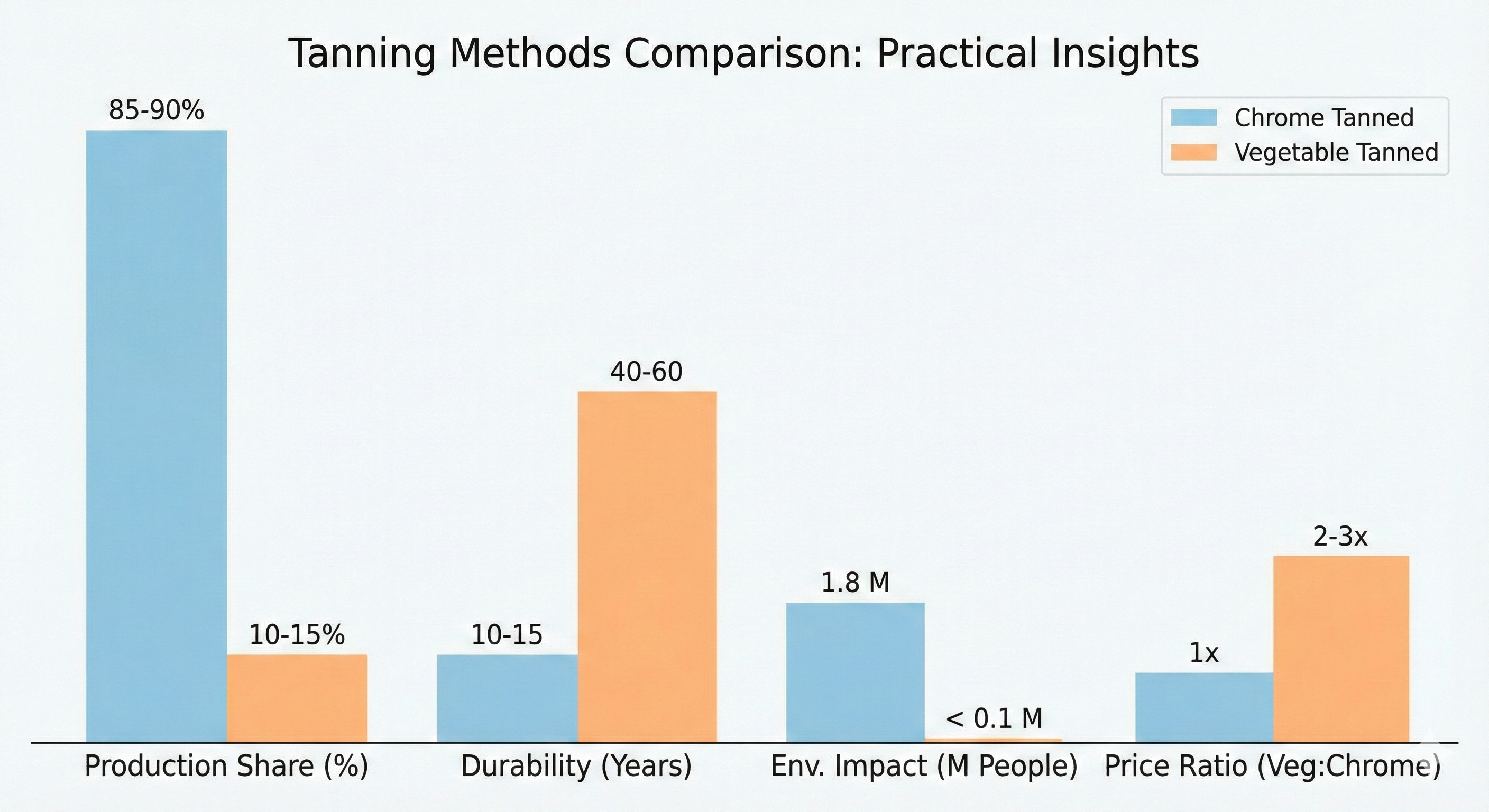
Understanding the data behind leather production helps you see the bigger picture of quality and availability.
Global Production Stats
The leather industry is massive, but it is heavily skewed toward one method. According to the United Nations Industrial Development Organization (UNIDO), approximately 85-90% of all leather produced globally is chrome-tanned. This dominance is due to speed and cost efficiency.
Durability Metrics
While chrome leather is popular, vegetable-tanned leather wins on longevity. Industry testing indicates that well-maintained vegetable-tanned leather can last 40 to 60 years, whereas average chrome-tanned goods often show significant wear within 10 to 15 years.
Environmental Costs
The Blacksmith Institute reports that chromium pollution from poorly regulated tanneries affects over 1.8 million people globally. This statistic drives the demand for sustainable vegetable tanning, which uses biodegradable materials.
Economic Value
The market reflects the time investment. Vegetable-tanned hides typically cost 2 to 3 times more than chrome-tanned hides of the same size. This price difference directly impacts the retail price of the final product.
Data Block: Key Leather Statistics
| Statistic | Figure | Source |
|---|---|---|
| Global share of chrome tanning | 85-90% | UNIDO |
| Lifespan of vegetable-tanned leather | 40-60 years | Industry Estimates |
| People affected by chromium pollution | 1.8 million | Blacksmith Institute |
| Cost multiplier for Veg-Tan vs Chrome | 2-3x | Market Analysis |
| Water usage reduction in eco-tanning | Up to 40% | Leather Working Group |
Comparing Chrome vs. Vegetable Tanning
The following table breaks down the practical differences between the two most common methods.
| Feature | Chrome Tanning | Vegetable Tanning |
|---|---|---|
| Production Time | 1-2 Days | 30-60 Days |
| Feel | Soft, pliable | Stiff, sturdy |
| Water Resistance | High | Low, absorbs water |
| Patina Potential | Low, uniform color | High develops character |
| Cost | Lower | Higher |
| Smell | Chemical odor | Earthy, woody scent |
Table Explanation:
This comparison highlights why price points vary so much in the leather market. Chrome tanning offers efficiency and uniformity, making it cheaper and more accessible. It resists water well but lacks the unique aging properties of vegetable leather. Vegetable tanning requires significantly more time and craftsmanship, resulting in a higher cost. However, it offers superior durability and the coveted patina that defines classic style. Choosing between them depends on whether you prioritize immediate softness and cost, or long-term character and environmental sustainability.
Real-World Examples of Leather Quality
Let’s look at simple numbers to illustrate value.
Imagine you buy a chrome-tanned belt for $30. It looks good for two years. Then the layers separate or the surface cracks. You replace it. Over 20 years, you might buy 10 belts. Total cost: $300.
Now, imagine you buy a vegetable-tanned belt for $80. It is stiff at first. After six months, it molds to your waist. It lasts for 20 years. Total cost: $80.
The "expensive" option was actually 73% cheaper in the long run. This is what we mean when we say "elegance meets durability."
Expert Insights on Quality
Master tanners agree that the method defines the product.
"You cannot hide the quality of the hide in vegetable tanning. The process is transparent. If the skin had a scratch, you would see it. Chrome tanning allows for more correction and sanding. Therefore, vegetable-tanned goods usually start with higher-grade hides by necessity."
This insight is crucial. When you choose vegetable-tanned leather, you are often implicitly choosing a higher grade of raw material. The tanning method acts as a filter for quality.
Learn: 5 Key Differences Between Soft and Hard Leather
Frequently Asked Questions
Which tanning method is better for the environment?
Vegetable tanning is generally considered better for the environment. It uses natural tannins from bark and leaves. The waste products are biodegradable. Chrome tanning uses heavy metals that can be toxic if not disposed of correctly. However, modern "eco-chrome" methods are improving.
Can I tell the difference by smell?
Yes, usually. Vegetable-tanned leather has a rich, earthy, sweet smell. It smells like "leather." Chrome-tanned leather often has a faint chemical smell or no smell at all.
Does vegetable-tanned leather get soft?
Yes. While it starts stiff, it breaks in beautifully. The heat from your body and the friction of daily use soften the fibers. It becomes custom-molded to your use, whether it is a wallet or a pair of boots.
Is the chrome-tanned leather of bad quality?
Not necessarily. It is just different. It is excellent for items that need to be soft, lightweight, and heat-resistant, like car seats or fashion gloves. "Bad quality" usually comes from using low-grade hides, regardless of the tanning method.
Summary
The tanning method is the DNA of your leather product. Chrome tanning offers softness, water resistance, and affordability, making it the global standard for mass-market goods. Vegetable tanning offers unmatched durability, a unique patina, and a more eco-friendly profile, representing the pinnacle of timeless craftsmanship.
Understanding these differences protects your investment. It helps you understand why a sustainably crafted bag costs more and why it is worth it. By choosing the right tanning method for your needs, you ensure your leather goods will serve you well for years to come.
Ready to Invest in Quality?
Don't settle for leather that won't last. Explore our collection of sustainably crafted, vegetable-tanned goods today. Experience the difference of true craftsmanship.
| |
Visit Our Leather Pants CollectionBrowse our full range of leather pants for parties, club nights, and play. Find cuts, fits, and finishes to match your style and scene. Visit collection |