

What is Bonded Leather: Complete Guide
15th Dec 2025

 |
Visit Our Leather Jackets CollectionBrowse our full range of leather Jackets for parties, club nights, and play. Find cuts, fits, and finishes to match your style and scene. Visit collection |
Executive Summary
Bonded leather is a manufactured material that combines shredded leather scraps with polyurethane or latex binders. The mixture gets pressed onto a fabric or paper backing and embossed to mimic genuine leather's appearance.
The material contains only 10-20% actual leather. The rest consists of synthetic polymers and binding agents.
Bonded leather costs less than genuine leather but offers significantly lower durability. Most bonded leather products crack, peel, or flake within 2 to 5 years of regular use.
You will find bonded leather in budget furniture, book covers, shoes, and accessories. Manufacturers also refer to it as reconstituted leather, composite leather, or blended leather.
What is Bonded Leather Made Of?
Bonded leather uses leftover leather scraps and fibers from genuine leather production. Manufacturers shred these scraps into small particles or pulp.
The production process involves four steps:
Shredding: Leather remnants get ground into fine particles or pulp.
Mixing: The pulp combines with polyurethane or latex adhesives (typically 80 to 90 percent of the final product).
Backing: The mixture gets rolled onto paper, cardboard, or fabric backing.
Finishing: A polyurethane coating covers the surface. Machines emboss artificial grain patterns to replicate real leather's texture.
The actual leather content varies by manufacturer. Most products contain 10 to 20 percent leather by weight. Some cheaper versions contain as little as 5 percent.
Read Our Article on Leather Buying Trends: How Habits Changed in 5 Years
Is Bonded Leather Real Leather?
No. Bonded leather is not real leather in the traditional sense.
The product contains small amounts of genuine leather fibers. However, the leather component makes up a minor fraction of the material. The majority consists of synthetic binders and coatings.
Think of bonded leather as particle board compared to solid wood. Both contain wood, but their construction and performance differ drastically.
The U.S. Federal Trade Commission requires manufacturers to disclose the percentage of actual leather content. The European Committee for Standardization mandates a minimum of 50 percent leather content by weight to use the term "bonded leather."
Many products sold in furniture stores contain less than this threshold.
How Bonded Leather Compares to Other Materials
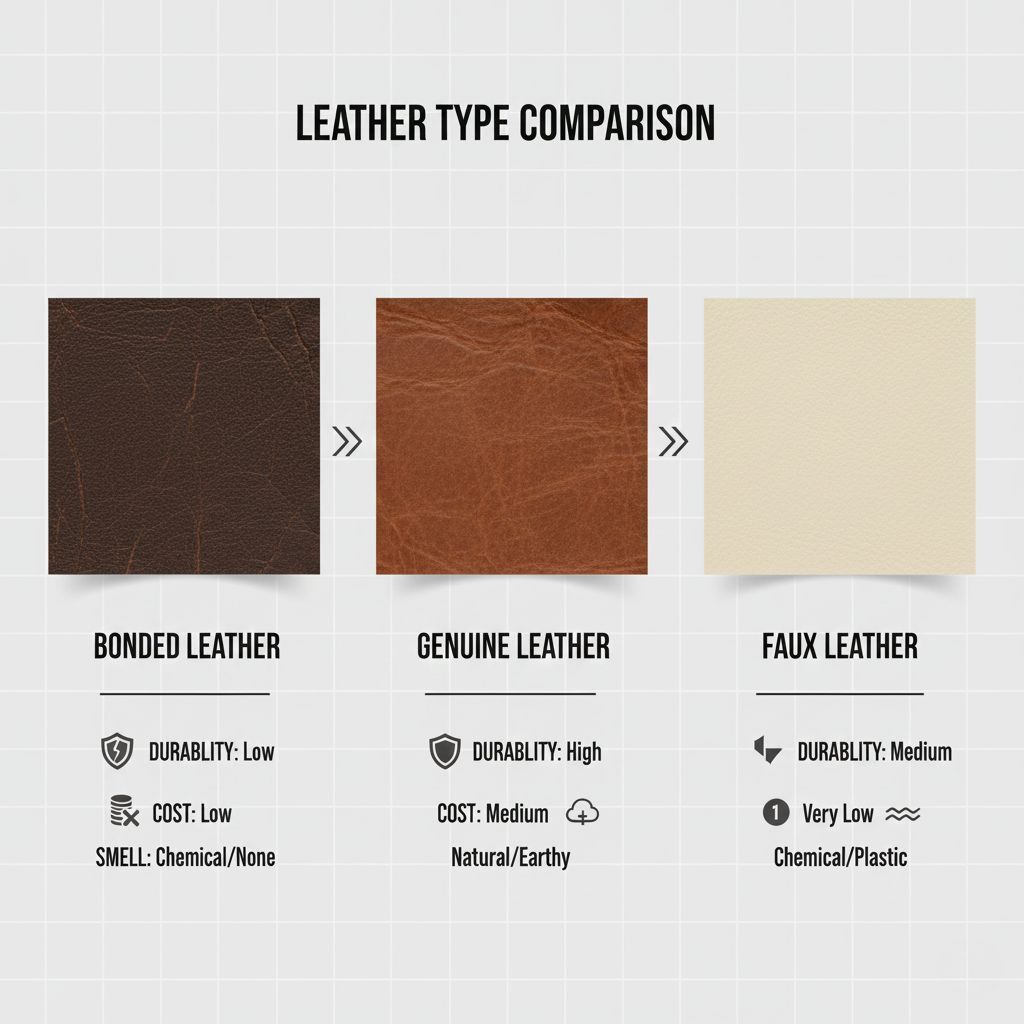
Bonded Leather vs Genuine Leather
Genuine leather comes from the lower layers of animal hide after the top grain is split away. It represents the third tier in leather quality rankings.
Composition: Genuine leather is 100 percent animal hide. Bonded leather contains 10 to 20 percent leather mixed with synthetics.
Durability: Genuine leather lasts 10 to 20 years with proper care. Bonded leather deteriorates within 2 to 5 years.
Texture: Genuine leather shows natural grain patterns and variations. Bonded leather displays uniform, machine-created patterns.
Price: Genuine leather costs 2 to 3 times more than bonded leather.
Smell: Genuine leather has a distinct natural odor. Bonded leather smells synthetic or chemical.
Bonded Leather vs Faux Leather
Faux leather (also called PU leather or vegan leather) contains zero animal products. Manufacturers create it entirely from polyurethane or PVC.
Composition: Bonded leather contains some real leather. Faux leather is 100 percent synthetic.
Durability: Both materials last 2 to 5 years. Faux leather may actually outlast bonded leather in some applications.
Ethics: Faux leather qualifies as vegan. Bonded leather uses animal byproducts.
Price: Faux leather typically costs less than bonded leather.
Appearance: Both can mimic real leather's look. Neither develops the patina that genuine leather acquires over time.
Bonded Leather vs Top Grain and Full Grain Leather
Top grain leather and full grain leather represent the highest quality leather grades.
Full-grain leather includes the entire thickness of the hide with all natural markings intact. Top grain leather gets sanded slightly to remove imperfections.
Durability: Full-grain and top-grain leather lasts 25 to 50+ years. Bonded leather lasts 2 to 5 years maximum.
Price: Full-grain leather costs 5 to 10 times more than bonded leather.
Aging: Premium leathers develop rich patinas and improve with age. Bonded leather only deteriorates.
Repairability: You can repair and recondition quality leather. You cannot repair bonded leather once it cracks or peels.
How Long Does Bonded Leather Last?
Bonded leather typically lasts 2 to 5 years under normal use conditions.
Several factors affect longevity:
Usage frequency: Daily use accelerates breakdown. A bonded leather sofa in a living room may start peeling within 18 to 24 months.
Climate conditions: Heat and humidity speed deterioration. Cold, dry environments slightly extend lifespan.
Quality variations: Higher leather content (15 to 20 percent) lasts longer than lower content (5 to 10 percent).
Backing material: Fabric-backed bonded leather outlasts paper-backed versions.
You will notice these signs of wear:
- Surface cracking appears first, usually within the first year
- Peeling occurs in high-contact areas like armrests and seat cushions
- Flaking follows as the polyurethane coating breaks down
- Color fading happens throughout the product's life
The material cannot be restored once deterioration begins. Unlike genuine leather, you cannot recondition or repair bonded leather.
Does Bonded Leather Crack and Peel?
Yes. Cracking and peeling represent the most common failure modes for bonded leather.
The problem stems from the material's construction. The polyurethane coating sits on top of the leather-synthetic mixture. This coating does not flex like genuine leather.
Why cracking occurs: Repeated flexing and stress cause the rigid surface coating to develop hairline cracks. These cracks widen over time.
Why peeling happens: Once cracks form, the coating separates from the backing layer. The thin material has no structural integrity to resist peeling.
High-risk areas: Seat cushions, armrests, and any surface that experiences regular contact crack and peel first.
You cannot prevent this deterioration. The material's design makes failure inevitable with regular use.
What is Bonded Leather Used For?
Manufacturers use bonded leather in products where low cost matters more than longevity.
Furniture Applications
Sofas and chairs: Budget furniture lines frequently use bonded leather for upholstery.
Office chairs: Many affordable desk chairs feature bonded leather seating surfaces.
Bar stools and dining chairs: Restaurants and homes use bonded leather for casual seating.
Book and Bible Covers
Religious texts: Bibles and prayer books commonly use paper-backed bonded leather.
Journals and diaries: Notebooks marketed as "leather-bound" often use bonded leather.
Planners and organizers: Many affordable leather-look planners use this material.
Fashion Accessories and Apparel
Handbags and purses: Budget-conscious brands produce bonded leather bags.
Belts and wallets: Low-cost leather goods often use bonded material.
Shoes: Some dress shoes and casual footwear incorporate bonded leather components.
Jacket trim: Manufacturers use bonded leather for collars, cuffs, and decorative elements.
Electronics Cases
Phone cases: Leather-style smartphone cases frequently use bonded material.
Tablet covers: Many protective covers market themselves as leather but use bonded material.
Laptop sleeves: Budget laptop accessories often feature bonded leather exteriors.
Advantages and Disadvantages of Bonded Leather
Advantages
Low cost: Bonded leather costs 50 to 80 percent less than genuine leather. This makes leather-look products accessible to more buyers.
Consistent appearance: Machine manufacturing produces uniform color and texture across all pieces. No natural variations or blemishes appear.
Color variety: Manufacturers can create any color easily. Genuine leather has limited dye options.
Initial aesthetics: New bonded leather products can look convincingly like real leather to untrained eyes.
Resource efficiency: The material uses leather scraps that would otherwise go to waste.
Disadvantages
Poor durability: The material lasts only 2 to 5 years. Genuine leather lasts decades.
Cannot be repaired: Once cracking or peeling starts, you cannot fix the damage. You must replace the entire item.
No patina development: The material only deteriorates. It never develops the rich character that genuine leather acquires.
Environmental concerns: Despite using leather scraps, the high synthetic content raises disposal issues. The material does not biodegrade like genuine leather.
Uncomfortable in heat: The polyurethane coating does not breathe. Sitting on bonded leather furniture in warm weather feels sticky and unpleasant.
Deceptive marketing: Many products labeled as "leather" turn out to be bonded leather. This misleads consumers expecting genuine leather.
Chemical odor: New bonded leather often smells artificial or plasticky. The odor may never fully dissipate.
Rapid deterioration: Unlike genuine leather that ages gracefully, bonded leather always looks worse as it ages.
How to Identify Bonded Leather
You can use four methods to recognize bonded leather:
1. Read the Label
Genuine leather products state "100% leather," "full grain leather," or "top grain leather" on their tags.
Bonded leather products often omit specific material information. They may say "leather" without qualification or use terms like "reconstituted leather" or "composite leather."
If the label seems vague or avoids direct statements about leather content, you likely face bonded leather.
2. Check the Price
Real leather costs significantly more to produce and sell.
A leather sofa under $500 almost certainly uses bonded leather. Genuine leather furniture typically starts at $1,500 to $2,000.
Leather handbags under $50 use faux or bonded leather. Quality genuine leather bags start around $150 to $200.
If the price seems too good to be true, it probably is.
3. Examine the Surface
Bonded leather shows: Perfectly uniform texture, regular grain patterns, smooth and consistent surface, no natural variations or marks.
Genuine leather shows: Natural grain variations, occasional marks or scars, irregular patterns, visible pores, depth, and character.
Look closely at the surface. Real leather looks organic and slightly imperfect. Bonded leather looks machined and artificial.
4. Touch Test
Run your fingers across the surface and press down gently.
Bonded leather feels: Cool to the touch, plastic-like texture, surface stays rigid when pressed, no give or flex, artificially smooth.
Genuine leather feels: Warm to the touch, soft and supple, surface wrinkles when pressed, natural give and flexibility, textured surface.
Press your finger into the material. Genuine leather compresses and wrinkles like skin. Bonded leather depresses while maintaining its smooth surface.
5. Smell Test
Genuine leather has a distinct, natural smell that cannot be replicated.
Bonded leather smells synthetic, chemical, or plasticky. Some products have no smell at all. Others have a strong artificial odor.
If you detect any chemical smell or the material lacks a leather scent entirely, you are dealing with bonded or faux leather.
Common Mistakes When Buying Bonded Leather
Mistake 1: Believing It Will Last Like Real Leather
Many buyers assume bonded leather offers genuine leather's durability at a lower price.
This assumption proves false. Bonded leather fails within a few years regardless of care. You will face replacement costs that exceed the initial savings.
Better choice: If the budget is tight, buy quality faux leather instead. It costs less and often outlasts bonded leather.
Or consider manufacturers like The Green Tanners who offer genuine leather goods at accessible price points without compromising quality.
Mistake 2: Expecting You Can Repair Damage
Some buyers believe they can fix cracking or peeling with leather conditioners or repair kits.
These products do not work on bonded leather. The synthetic coating cannot absorb conditioners. Repair compounds cannot rebond the separated layers.
Once damage appears, replacement is your only option.
Mistake 3: Not Reading Product Labels Carefully
Retailers often display bonded leather products in the same areas as genuine leather items.
Vague labeling or small print can mislead you. Always demand a clear specification of the material type before purchasing.
Mistake 4: Assuming "Leather" Means Genuine Leather
The word "leather" alone does not guarantee genuine leather.
Manufacturers can legally use terms like "bonded leather," "leather match," or "blended leather" and still call their products "leather."
Ask specifically: "Is this 100% genuine leather or bonded leather?"
Mistake 5: Prioritizing Initial Appearance Over Longevity
New bonded leather looks attractive in showrooms under controlled lighting.
Focus on how the product will look in 2 to 3 years, not how it looks today. Consider the total cost of ownership, including replacement.
How to Care for Bonded Leather
Bonded leather requires minimal maintenance because conditioning provides no benefit.
Regular Cleaning
Frequency: Clean every 2 to 4 weeks.
Method: Use a slightly damp microfiber cloth to wipe surfaces. Remove dust and light dirt.
Products: Mild soap and water work for tougher stains. Avoid harsh chemicals that can damage the coating.
Do not saturate the material. Excess moisture can weaken the backing layer and accelerate peeling.
Stain Removal
Act quickly: Blot spills immediately with a clean, dry cloth.
Avoid rubbing: Rubbing spreads the stain and can damage the surface coating.
Test first: Try cleaning products on an inconspicuous area before treating visible surfaces.
What to Avoid
No leather conditioners: The synthetic coating cannot absorb conditioners. You will just create a sticky, greasy surface.
No harsh cleaners: Ammonia, bleach, or solvent-based cleaners break down the polyurethane coating.
No heat exposure: Keep bonded leather away from heating vents, radiators, and direct sunlight. Heat accelerates deterioration.
No sharp objects: The thin coating tears easily. Keep pets' claws trimmed if they use bonded leather furniture.
Extending Lifespan
You cannot prevent eventual deterioration, but you can slow it slightly:
- Rotate cushions monthly to distribute wear
- Use throws or slipcovers on high-contact areas
- Keep the room temperature moderate (60 to 75°F)
- Maintain humidity between 40 and 55 percent
- Clean spills immediately to prevent staining
- Avoid sitting in the same spot repeatedly
Even with perfect care, expect bonded leather to fail within 5 years.
Industry Labeling Standards
Regulations vary by region regarding bonded leather labeling.
United States
The Federal Trade Commission (FTC) provides guidelines for leather product labeling.
Manufacturers must disclose the percentage of genuine leather in bonded leather products. Labels should clearly distinguish bonded leather from genuine leather.
However, enforcement remains inconsistent. Many retailers still use misleading terminology.
European Union
The European Committee for Standardization published EN 15987:2011, which defines leather terminology standards.
Under these standards, products must contain at least 50 percent leather by weight to use the term "bonded leather."
Products with lower leather content must be labeled as synthetic or composite materials.
Consumer Protection
Always ask for written material specifications before purchasing. If a seller cannot provide clear documentation, assume the product uses low-quality materials.
Reputable manufacturers clearly state their leather grades. Vague or evasive descriptions signal inferior materials.
Frequently Asked Questions
Is bonded leather as good as real leather?
No. Bonded leather contains only 10 to 20 percent real leather mixed with synthetics. Real leather lasts decades while bonded leather fails within 2 to 5 years. You cannot repair bonded leather once it cracks or peels.
How long does bonded leather last?
Bonded leather typically lasts 2 to 5 years under normal use. Heavy-use areas like sofa seats may show damage within 18 months. The material cannot be repaired once deterioration begins.
What are the main disadvantages of bonded leather?
Bonded leather cracks and peels within a few years. You cannot repair or restore it. The material feels uncomfortable in the heat and smells artificial. Despite being marketed as leather, it performs more like vinyl or plastic.
Does bonded leather crack and peel?
Yes. All bonded leather eventually cracks and peels. The rigid polyurethane coating cannot flex like genuine leather. Repeated use causes cracking, which leads to peeling. High-contact areas fail first.
What is the difference between bonded leather and genuine leather?
Genuine leather is 100 percent animal hide and lasts 10 to 20 years. Bonded leather contains 10 to 20 percent leather scraps mixed with polyurethane and lasts 2 to 5 years. Genuine leather can be repaired and conditioned. Bonded leather cannot.
What is the difference between bonded leather and faux leather?
Bonded leather contains 10 to 20 percent real leather scraps. Faux leather is 100 percent synthetic (usually polyurethane or PVC). Faux leather qualifies as vegan. Bonded leather uses animal byproducts. Both materials last about the same time (2 to 5 years).
What is bonded leather used for?
Bonded leather appears in budget furniture, book covers, fashion accessories, shoes, and electronics cases. Manufacturers use it when low cost matters more than durability.
Is bonded leather durable?
No. Bonded leather has poor durability compared to genuine leather. The material starts cracking within the first year of regular use and typically fails within 2 to 5 years.
Can you condition bonded leather?
No. Bonded leather's synthetic coating cannot absorb leather conditioners. Applying conditioner creates a sticky, greasy surface without providing any benefit.
Is bonded leather real leather?
Bonded leather contains 10 to 20 percent real leather scraps but is not considered genuine leather. The material is primarily synthetic (80 to 90 percent polyurethane or latex binder).
Actionable Takeaways
Avoid bonded leather for long-term purchases. If you need furniture, accessories, or goods that should last more than a few years, do not buy bonded leather.
Choose genuine leather or quality faux leather instead. Genuine leather lasts decades. Good faux leather costs less than bonded leather and often outlasts it.
Read all labels before buying. Demand a clear specification of the material type. If the label seems vague, ask for written documentation.
Calculate the total cost of ownership. A $400 bonded leather sofa that needs replacement in 3 years costs more than a $1,200 genuine leather sofa that lasts 20 years.
Understand that cheap leather goods use bonded material. Real leather has a minimum cost. Anything priced significantly below market value uses bonded or faux leather.
Do not expect leather performance from bonded leather. The material will crack, peel, and deteriorate. This is inevitable, not preventable.
Ask direct questions when shopping. Specifically ask: "Is this 100% genuine leather, bonded leather, or synthetic?" Do not accept vague answers.
Buy bonded leather only for short-term use. If you need temporary furniture, disposable accessories, or products you will replace soon anyway, bonded leather's low cost may make sense.
Prioritize longevity over initial savings. The cheapest option today often costs more over time when you factor in replacements.
Understand that bonded leather cannot be repaired. Budget for full replacement when damage occurs, not repair costs.