
Leather Buying Trends: How Habits Changed in 5 Years
Posted by The Green Tanners on 12th Dec 2025
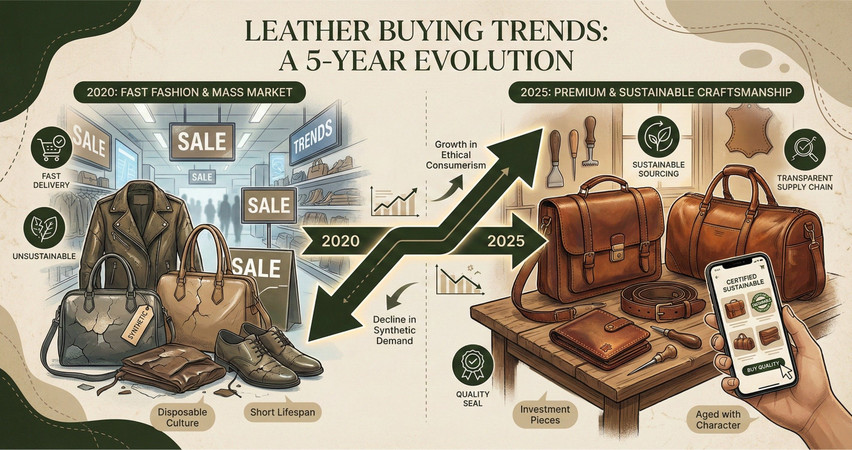
Leather buying habits shifted from fast fashion to sustainable investments recently. Consumers now prioritize longevity and ethical sourcing over low prices. This guide explores exactly how the market has evolved.
The Core Question: How Have Consumer Priorities Shifted?
The most significant change in the last five years is the move toward "conscious investment." Buyers no longer want cheap leather goods that peel or crack after a few months. Instead, they actively seek transparent supply chains, vegetable-tanned options, and heritage quality. Trust has become the most valuable currency in the leather market.
Essential Leather Terminology
Before we analyze the trends, you must understand the product. Many consumers now educate themselves on these terms before purchasing.
Tanning
Tanning is the chemical process that turns raw animal hide into durable leather. It stops decomposition. The two main methods are Chrome Tanning (fast, uses harsh chemicals, accounts for about 80% of global leather) and Vegetable Tanning (slow, uses natural tannins from tree bark, eco-friendly).
Grain
Grain refers to the outer surface of the hide. Full-grain is the top layer with all-natural markings and is the strongest. Top-grain has the top layer sanded off to remove imperfections. Genuine leather is often a marketing term for lower layers glued together.
Thickness
Thickness determines durability and feel. It is usually measured in millimetres (mm) or ounces. A heavy belt might be 3.5mm thick, while a wallet might use 1.2mm leather to reduce bulk.
Leather Grades
Grades rank the quality of the hide.
- Grade 1 (Full Grain): Highest quality, most expensive.
- Grade 2 (Top Grain): Good quality, more uniform.
- Grade 3 (Genuine/Split): Lower durability, cheaper finish.
- Grade 4 (Bonded): Leftover scraps glued together.
Major Buying Trends of the Last Five Years
The Surge in Eco-Conscious Shopping
Five years ago, style was the primary driver for leather purchases. Today, sustainability rivals aesthetics. Consumers ask where the leather comes from. They want to know if the tannery treats its water. Brands like The Green Tanners, one of the largest and authentic leather goods brands, have seen growth because they align with this demand for transparency. Buyers want products that do not harm the planet.
The Shift from Brick-and-Mortar to Digital
Historically, people refused to buy leather without touching it. They needed to smell the leather and feel the texture. That changed drastically. Improved return policies and high-quality product photography gave buyers confidence. Now, a significant portion of high-end leather sales happens on mobile devices.
The "Buy Less, Buy Better" Movement
Economic fluctuations forced buyers to rethink spending. Instead of buying four cheap bags in five years, a customer now buys one high-quality bag. This trend focuses on "Cost Per Wear." Consumers understand that a $200 bag that lasts a decade is cheaper than a $50 bag that lasts six months.
Data-Driven Insights: The Numbers Behind the Shift
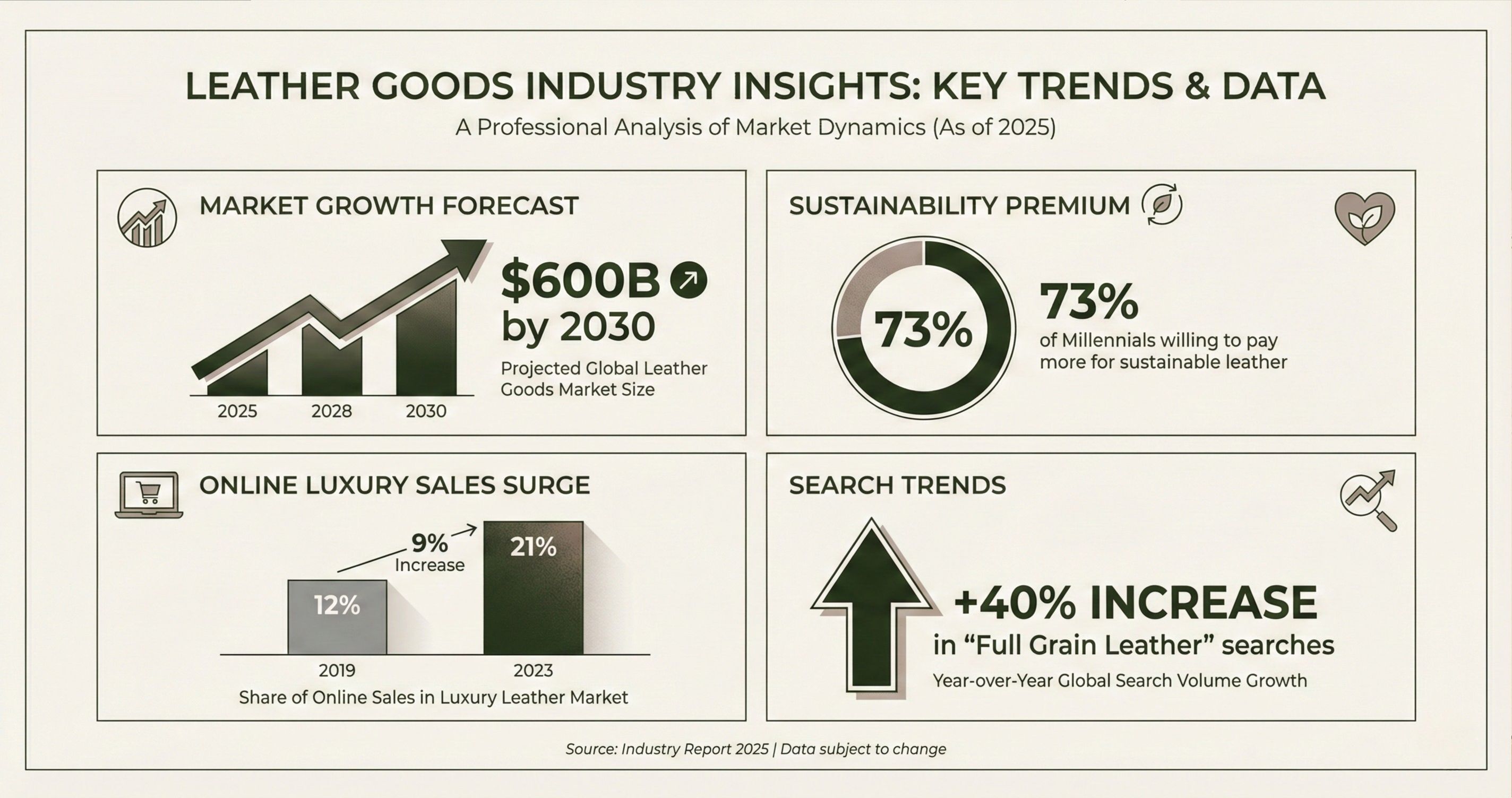
The data support these observations clearly. The global leather goods market has not just grown; it has transformed in composition. Market analysis shows a clear trajectory toward premium items.
According to recent industry reports, the global leather goods market size was valued at approximately USD 420 billion in 2023 and is expected to grow steadily. However, the most interesting data point is the consumer's willingness to pay. Studies indicate that nearly 73% of global millennials are willing to pay more for sustainable goods. This is a massive jump compared to five years ago.
Furthermore, the online share of personal luxury goods, which heavily includes leather handbags and wallets, has nearly doubled since 2019. In 2019, e-commerce made up roughly 12% of the market. By the end of 2023, that number hovered near 20-22%.
We also see a decline in "synthetic" leather popularity among purists. While "vegan" leather made headlines, many consumers realized that plastic-based alternatives (PU or PVC) do not biodegrade. This realization drove a return to authentic, vegetable-tanned leather, which is biodegradable and durable. The data proves that while volume sales for cheap goods remain high, the value growth is in the authentic sector.
Key Market Statistics
- Market Growth: The global leather goods market is projected to reach over USD 600 billion by 2030 (Grand View Research).
- Sustainability Premium: 73% of millennials are willing to spend more on sustainable brands (NielsenIQ).
- Online Penetration: Online sales of luxury leather goods nearly doubled from ~12% in 2019 to over 20% in 2023 (Bain & Company).
- Durability Focus: Searches for "full grain leather" have increased by over 40% in the last five years, according to SEO trend data.
Comparing Fast Fashion vs. Authentic Leather
The table below illustrates why consumers are switching from mass-market options to authentic brands like The Green Tanners.
| Feature | Fast Fashion Leather (Mass Market) | Authentic Leather (Specialty Brand) |
|---|---|---|
| Material Source | Often "Genuine Leather", Split or Bonded | Full Grain or Top Grain |
| Tanning Method | Chrome Tanning, chemical-heavy | Vegetable or Semi-Veg Tanning |
| Lifespan | 6 months to 2 years | 10 to 30 years |
| Aging | Peels, cracks, looks worn out | Develops a patina, looks better with age |
| Repairability | Difficult to repair | Easy to stitch or condition |
Understanding the Trade-Offs
The comparison above highlights a distinct value gap. Fast fashion leather provides instant gratification at a low entry cost. However, it lacks longevity. The material often degrades rapidly because it uses lower-grade hides coated with polyurethane. In contrast, authentic leather requires a higher initial investment. But it offers a completely different ownership experience. It does not break; it evolves. The patina, the soft sheen that develops over time, is impossible to replicate in cheap materials. This difference drives the current trend toward heritage brands.
Simple Examples of Value
Let's look at the math that smart consumers are doing today.
Scenario A:
You buy a low-quality belt for $30. The holes stretch out after six months. The layers separate after a year. You replace it annually.
- 5-Year Cost: $150 (5 belts x $30).
- Result: You own a broken belt.
Scenario B:
You buy a full-grain belt from an authentic brand for $80. It does not stretch. It looks better in year three than in year one.
- 5-Year Cost: $80.
- Savings: $70.
- Result: You own a beautiful, durable item.
Expert Insights on Leather Quality
True leather experts look for specific indicators of quality.
- The Smell: Real leather smells earthy and rich. Chemical smells indicate cheap processing.
- The Edges: Burnished or painted edges should be smooth. If the edge looks like plastic paint, it hides poor layering.
- The Pores: Full-grain leather has visible pores. It looks like skin because it is skin. Perfectly smooth, plastic-like surfaces often indicate heavy processing.
"The modern consumer is a researcher. They check the grain, they ask about the stitching, and they care about the origin. Brands can no longer hide behind a logo. Quality is the only thing that sustains loyalty now."
Recommended Resources
To help you make the best purchase, review these guides on our site:
- Leather Working Group (LWG): For information on environmental auditing in the leather industry.
- ICT (International Council of Tanners): For global industry standards and trade definitions.
Frequently Asked Questions
Why has the price of leather goods increased recently?
Raw material costs have risen globally. Supply chain disruptions and higher environmental standards for tanneries also contribute to the cost. However, higher prices often reflect better ethical practices and higher wages for artisans.
Is vegan leather better than real leather?
It depends on your definition of "better." Most vegan leather is made from plastic (PVC or PU), which does not decompose and releases microplastics. Authentic vegetable-tanned leather is a byproduct of the food industry and is biodegradable. Real leather also lasts significantly longer than plastic alternatives.
How do I know if I am buying good leather online?
Read the description carefully. Look for "Full Grain" or "Top Grain." Avoid products that only say "Genuine Leather." Check for close-up photos of the texture. Read reviews that mention durability over several months, not just "it looks nice out of the box."
What is the most durable type of leather?
Full-grain leather is the most durable. It retains the dense fibre structure of the hide's outer layer. It resists moisture and tearing better than any other grade.
Do The Green Tanners use real leather?
Yes. As one of the largest and authentic leather goods brands, we prioritize high-quality, genuine hides that age beautifully and last for decades.
Conclusion
Consumer buying trends for leather goods have matured significantly in the last five years. The market has moved away from disposable fashion toward sustainable, high-quality investments. Buyers now prioritize full-grain materials, transparent production, and long-term value. This shift benefits everyone. It reduces waste, supports skilled artisans, and gives you a product that tells a story.
Are you ready to invest in a piece that lasts a lifetime?
Explore our collection of authentic, handcrafted leather goods at The Green Tanners today and feel the difference quality makes.